Introduction
Artificial Intelligence (AI) is no longer a futuristic concept discussed only in research labs or sci-fi movies. It has become a powerful, practical force that is actively reshaping the Information Technology (IT) industry. From how software is written and tested to how infrastructure is managed and secured, AI is changing the rules of the game. For decades, the IT industry has evolved through automation, cloud computing, mobile technologies, and big data. AI represents the next major leap—one that not only automates tasks but also enables systems to learn, reason, and make decisions. As organizations race to become more efficient, scalable, and intelligent, AI is emerging as a core pillar of modern IT strategies.
This blog explores how AI is impacting the IT industry, the opportunities it creates, the challenges it introduces, and what the future may look like for IT professionals and businesses alike.
The Rise of AI in the IT Ecosystem
AI adoption in IT has accelerated rapidly due to three key factors:
- Explosion of Data – Organizations now generate massive amounts of data from applications, users, and devices. AI thrives on data, making it the perfect tool to extract insights.
- Advances in Computing Power – Cloud platforms and GPUs have made it possible to train and deploy AI models at scale.
- Mature Algorithms and Tools – Machine learning frameworks, pre-trained models, and AI services have lowered the barrier to entry for businesses.
As a result, AI is no longer limited to niche use cases. It is embedded across software development, IT operations, cybersecurity, customer support, and enterprise decision-making.
AI in Software Development
One of the most visible impacts of AI in IT is in software development. Traditionally, building software required significant manual effort—from writing code to debugging and testing. AI is transforming each stage of the software development lifecycle (SDLC).
Smarter Coding and Development Assistance
AI-powered tools can now suggest code snippets, detect bugs, and recommend best practices in real time. Developers can write cleaner code faster, reduce repetitive work, and focus more on solving business problems rather than syntax issues.
AI also helps in understanding legacy codebases by analyzing patterns and documentation, making modernization projects less risky and more efficient.
Automated Testing and Quality Assurance
Testing has always been time-consuming and resource-intensive. AI-driven testing tools can automatically generate test cases, predict high-risk areas in applications, and identify defects early in the development cycle. This leads to faster releases, improved software quality, and reduced costs.
Faster Time to Market
By automating repetitive development and testing tasks, AI enables organizations to deliver applications more quickly. In a competitive digital landscape, this speed can be a major advantage.
AI in IT Operations (AIOps)
IT operations have become increasingly complex with distributed systems, microservices, and cloud-native architectures. Managing such environments manually is both difficult and error-prone. This is where AIOps (Artificial Intelligence for IT Operations) comes into play.
Predictive Monitoring and Issue Resolution
AI systems analyze logs, metrics, and events to detect anomalies before they cause outages. Instead of reacting to incidents, IT teams can proactively address potential issues, improving system reliability and uptime.
Root Cause Analysis
When failures do occur, AI can correlate data across systems to quickly identify the root cause. This drastically reduces mean time to resolution (MTTR) and minimizes business disruption.
Intelligent Automation
Routine operational tasks—such as server provisioning, load balancing, and capacity planning—can be automated using AI. This allows IT teams to focus on strategic initiatives rather than firefighting daily issues.
AI and Cybersecurity
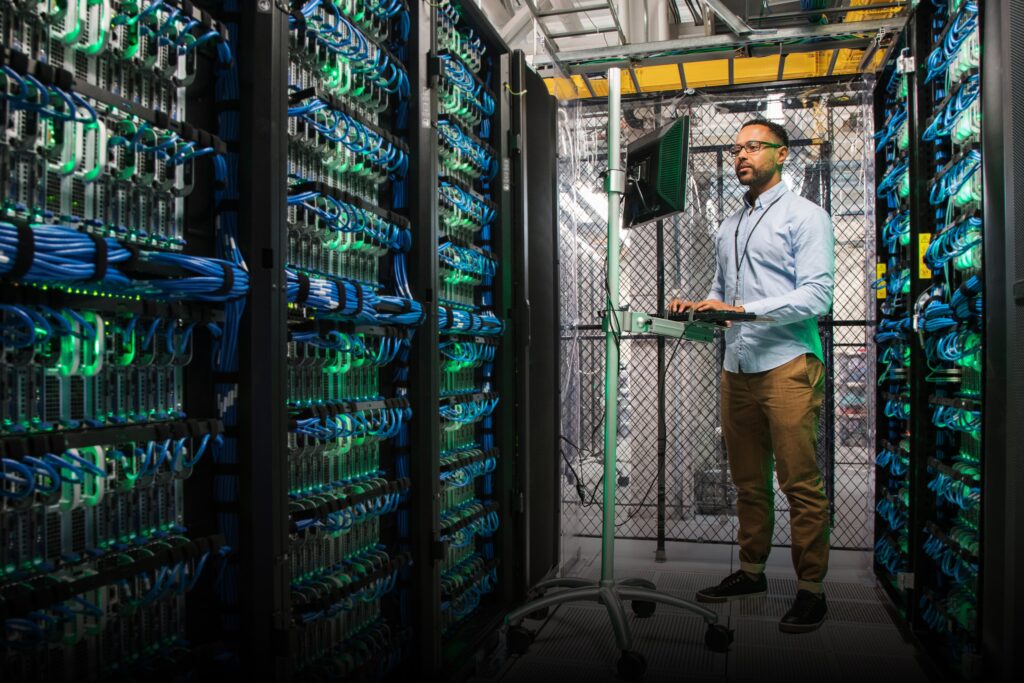
Cybersecurity is one of the most critical areas where AI is making a significant impact. As cyber threats grow in volume and sophistication, traditional rule-based security systems are no longer sufficient.
Threat Detection and Prevention
AI can analyze vast amounts of network traffic and user behavior to identify suspicious patterns in real time. Unlike static rules, AI models continuously learn and adapt to new threats, making them more effective against zero-day attacks.
Fraud Detection
In sectors like banking, e-commerce, and telecom, AI is widely used to detect fraudulent activities. By learning normal behavior patterns, AI can quickly flag anomalies that may indicate fraud or data breaches.
Security Automation
AI-driven security tools can automatically respond to threats by isolating affected systems, blocking malicious IPs, or triggering alerts. This rapid response is crucial in minimizing damage.
AI in Data Management and Analytics
Data has always been central to IT, but AI takes data management and analytics to a new level.
Intelligent Data Processing
AI can clean, classify, and organize massive datasets far more efficiently than manual processes. This improves data quality and ensures more accurate analytics.
Advanced Insights and Decision-Making
Machine learning models can uncover hidden patterns, predict trends, and provide actionable insights. IT leaders and business stakeholders can make data-driven decisions with greater confidence.
Real-Time Analytics
AI enables real-time data processing, allowing organizations to respond instantly to changing conditions—whether it’s system performance, customer behavior, or market trends.
AI in Customer Support and IT Service Management
Customer expectations for fast, accurate support are higher than ever. AI is playing a key role in modernizing IT service management (ITSM).
Chatbots and Virtual Assistants
AI-powered chatbots handle common IT queries such as password resets, system access requests, and troubleshooting steps. This reduces the workload on helpdesk teams and improves response times.
Personalized Support
By analyzing user history and behavior, AI can offer personalized solutions and recommendations, leading to better user experiences.
Improved SLA Management
AI helps predict ticket volumes, prioritize issues, and optimize resource allocation, ensuring service-level agreements (SLAs) are consistently met.
Impact on IT Jobs and Skills
One of the most discussed aspects of AI in IT is its impact on jobs. While there are concerns about automation replacing human roles, the reality is more nuanced.
Job Transformation, Not Elimination
AI is automating repetitive and low-value tasks, allowing IT professionals to focus on higher-level responsibilities such as system design, architecture, strategy, and innovation.
Demand for New Skills
There is a growing demand for skills in AI, machine learning, data engineering, cloud computing, and cybersecurity. Professionals who adapt and upskill will find more opportunities, not fewer.
Human-AI Collaboration
The future of IT is not about humans versus AI, but humans working alongside AI. Creativity, critical thinking, and domain knowledge remain uniquely human strengths that AI enhances rather than replaces.
Challenges and Ethical Considerations
Despite its benefits, AI adoption in IT comes with challenges.
Data Privacy and Security
AI systems rely heavily on data, raising concerns about data privacy, compliance, and misuse. Organizations must ensure ethical data practices and strong governance.
Bias and Transparency
AI models can inherit biases present in training data, leading to unfair or inaccurate outcomes. Transparency and explainability are critical to building trust in AI systems.
Integration Complexity
Integrating AI into existing IT infrastructure can be complex and costly. It requires careful planning, skilled resources, and cultural change within organizations.
The Future of AI in the IT Industry
Looking ahead, AI will become even more deeply embedded in the IT industry. We can expect:
- Greater adoption of autonomous systems that self-heal and self-optimize
- More intelligent and secure digital infrastructures
- Increased convergence of AI with technologies like cloud, IoT, and edge computing
Organizations that embrace AI strategically will gain a competitive edge, while those that resist change risk falling behind.
Conclusion
AI is fundamentally transforming the IT industry. It is redefining how software is built, how systems are managed, how data is analyzed, and how security is enforced. While challenges exist, the opportunities far outweigh the risks for organizations and professionals willing to adapt.
The IT industry has always been about innovation and evolution. AI is simply the next chapter—one that promises smarter systems, faster growth, and a more intelligent digital future.
If leveraged responsibly and thoughtfully, AI will not replace the IT industry—it will elevate it to new heights.